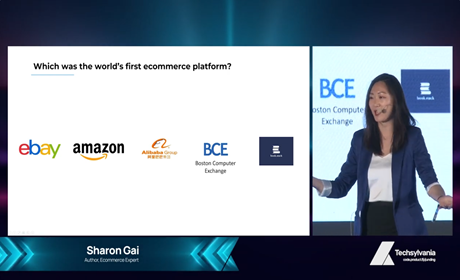
Sharon Gai

“HOW TO DO MORE WITH LESS USING AI”

One of the Most Influential Voices Globally in AI. Linkedin Top Voice. Founder & CEO, Culture Fluid. Head of Global Key Accounts, Alibaba (2019-22).

Sharon Gai speaker, conferencias, AI, Alibaba, autora
Chino · English

Sharon Gai is a renowned author and expert in Artificial Intelligence, innovation, e-commerce, and digital transformation, with a professional career spanning the United States and China. Her perspective is especially valuable for organizations that need to understand how technology is reshaping markets, consumer behavior, and business competitiveness.


Her vision stems from an idea particularly relevant to today’s business landscape: the question is no longer whether companies will adopt AI, but how they will do so and what competitive advantage they will be able to gain from it. Therefore, her presentations aim to shift the conversation from technological enthusiasm to practical application.


Her experience is particularly relevant due to her time at Alibaba, a major player in the digital revolution and global e-commerce. During her tenure at the company, she held positions of responsibility related to the e-commerce business, eventually becoming Head of Global Key Accounts. There, she worked with major brands and organizations, advising on digital strategy, programmatic marketing, artificial intelligence, and new business-to-consumer relationship models.

Her knowledge of the Chinese market allows her to explain to Western companies phenomena that, while later becoming global trends, have been developing on a large scale in China for years: data-driven personalization, platform and commerce integration, consumer-to-manufacturer (C2M) models, digital ecosystems, social commerce, automation, and the use of AI to understand and anticipate consumer needs.

Building on this experience, Sharon Gai has forged an international career as a consultant, author, and keynote speaker, helping organizations interpret technological disruption and transform it into concrete business opportunities. Her discourse currently lies at the intersection of Artificial Intelligence, Agentic AI, innovation, e-commerce, the future of work, and business transformation.


Her most recent specialization focuses on Agentic AI, a new generation of artificial intelligence systems capable not only of generating content or answering questions, but also of executing tasks, making decisions, and optimizing processes with an increasing degree of autonomy.


She is also the author of “How to Do More with Less Using AI,” a book designed to help organizations use artificial intelligence to increase productivity and accomplish more with limited teams and resources. In it, she proposes frameworks for determining which parts of the work can be delegated to AI, how to identify automation opportunities, and how to use these tools to improve business processes and decisions. She previously published “Ecommerce Reimagined,” a practical and strategic guide to understanding the e-commerce ecosystem in China.

Sharon Gai has collaborated with TEDx, Singularity University, UBS, Deloitte, Walmart, LVMH, Nestlé, Coca-Cola, Lenovo, and many other companies. She is listed among the AAE’s top speakers of 2023. Sharon Gai is one of the most influential voices in AI for 2026, the leading retail expert at RETHINK Retail, and one of the top voices in the LinkedIn community for 2024. She has appeared on CNN, NBC, Bloomberg, Reuters, ABC, CBC, CCTV, TechCrunch, and The Next Web.

One of Sharon Gai’s key strengths is her ability to translate complex technologies into understandable business implications. Her audience doesn’t need to be an AI expert to benefit from her presentations. Her goal is precisely to explain what’s happening, why it matters to an organization, and, most importantly, what a company should start doing to avoid falling behind.
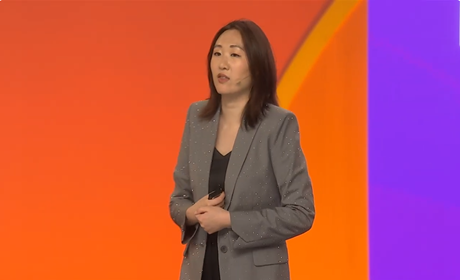
How to do more with less: Future-Proofing in the Age of AI.

For decades, organizations were built for human labor. Reporting lines reflected tasks. Departments reflected functions. And leaders optimized for efficiency by asking people to do more, faster. Pre AI, most of us moved through our workdays like busy bees. Email. Approvals. Reports. Meetings. Reviews. The org chart was a map of human effort. Post AI, that logic breaks.

In this reflective, CEO level session, we explore the shift from being busy bees to becoming beekeepers. Leaders must design systems, oversee swarms of digital labor, and focus human talent on judgment, taste, strategy, and trust. We will examine the most cutting edge AI tools, agent frameworks, and emerging enterprise use cases, and then step back to ask the deeper question: What does leadership look like when labor is no longer the constraint?.

Key Takeaways:

● A clear mental model for moving from task based org charts to capability based, AI enabled structures.
● Understanding the current state of AI, including frontier models, autonomous agents, multi agent systems, and enterprise copilots.
● A framework for identifying which roles should be automated, augmented, or elevated.
● How to redesign reporting lines when AI systems handle execution and humans focus on judgment.

Loop Engineering: A Step Beyond Prompt Engineering.

Most organizations crossed the adoption line last year. The agents are live, they are working overnight, and almost nobody can answer the follow-up question: who is engineering how they run? Sharon Gai spent years inside Alibaba watching automation absorb work that used to require hiring, and her "busy bees to beekeepers" framework has helped teams at Walmart, Coca-Cola and Mastercard make the shift from doing the work to directing it.

This keynote takes on what comes after that shift. She introduces loop engineering, the practice of designing closed systems that trigger work, let AI iterate and verify itself, and escalate to a person only when judgment or risk requires it, then shows why two teams can build the identical loop and get opposite results.

Audiences leave with a design pattern any non-technical team can apply (triggers, verification checkpoints, stop rules), a clear map of where human approval has to sit including cost limits and irreversible decisions, a way to spot cognitive surrender before it costs them, and a plan for moving from managing individual agents to running the system that runs them.

What if AI can do 95% of each person’s job instead of 95% of all jobs?.

As AI systems are able to take on longer and longer tasks that humans were originally hired to do, knowledge workers must adapt to stay relevant. But there is also a missing piece to the puzzle. There are a wealth of things that AI is bad at: being original, critical thinking, having theory of mind and many others. Knowledge workers of today must learn this sharp difference and reorient their skills for this new age. Sharon Gai, who saw the power of Gen AI in 2018 change her team at Alibaba learned this lesson early.

In this energising keynote, Sharon shows how individuals and teams can build the mindset, skills, and habits that keep them relevant and future-ready in an economy shaped by automation and intelligent tools.

Takeaways:

● How to upgrade your mindset to stay relevant as AI reshapes every industry.
● Daily practices that build adaptability, resilience, and creative thinking.
● How to use AI to work smarter, not harder, so your value increases over time.
● What skills matter most in an AI-powered workplace and how to develop them.
● How to future-proof your career by embracing change instead of resisting it.

How to Do More with Less: Future-Proofing Yourself in an AI-driven Economy.

Una guía estratégica honesta y práctica para trabajar en un mundo transformado por la IA

En el entorno laboral actual, las noticias sobre inteligencia artificial pueden resultar abrumadoras. Con titulares que oscilan entre promesas utópicas y advertencias de desempleo masivo, para la mayoría de los profesionales del conocimiento, la realidad resulta confusa.

En este libro, Sharon Gai aclara la situación. Basándose en ejemplos reales y perspectivas globales, explica cómo la IA está transformando nuestra forma de trabajar, sin exageraciones ni alarmismo. En lugar de optar entre un optimismo ciego o un pesimismo absoluto, ofrece una perspectiva práctica y equilibrada que ayuda a los lectores a comprender el panorama de la IA, en constante evolución.

Aprenderás a:

> Recapacitar y preparar tu carrera para el futuro ante la disrupción de la IA.
> Identificar qué aspectos de tu trabajo pueden automatizarse y cuáles requieren creatividad y criterio humano.
> Utilizar marcos de trabajo probados para evaluar el impacto de la IA en tu trabajo y tu organización.
> Aplicar consejos y herramientas prácticas para aumentar la productividad, tomar decisiones más inteligentes y lograr más con menos.

How to Do More with Less: Future-Proofing Yourself in an AI-driven Economy.

Ecommerce Reimagined: Retail and Ecommerce in China.

Este libro ofrece una guía práctica sobre los mercados de comercio electrónico chinos para empresarios y académicos. China representa un mercado minorista de 5,6 billones de dólares, con la mayor tasa de penetración del comercio electrónico del mundo. Debido a la pandemia de COVID-19, las marcas están invirtiendo más en el crecimiento de las ventas en línea.

Escrito desde el corazón de la plataforma de comercio electrónico más grande del mundo, «Ecommerce Reimagined: Retail and Ecommerce in China» es un libro que busca satisfacer la creciente necesidad de emprendedores y empresas que desean acceder al mercado chino, y proporcionar contexto a estudiantes y académicos interesados ​​en aprender cómo el comercio electrónico ha transformado el sector minorista chino.

Ecommerce Reimagined: Retail and Ecommerce in China.